From Head to Toe: A Dermatologist Walks You Through a Full-Body Skin Exam
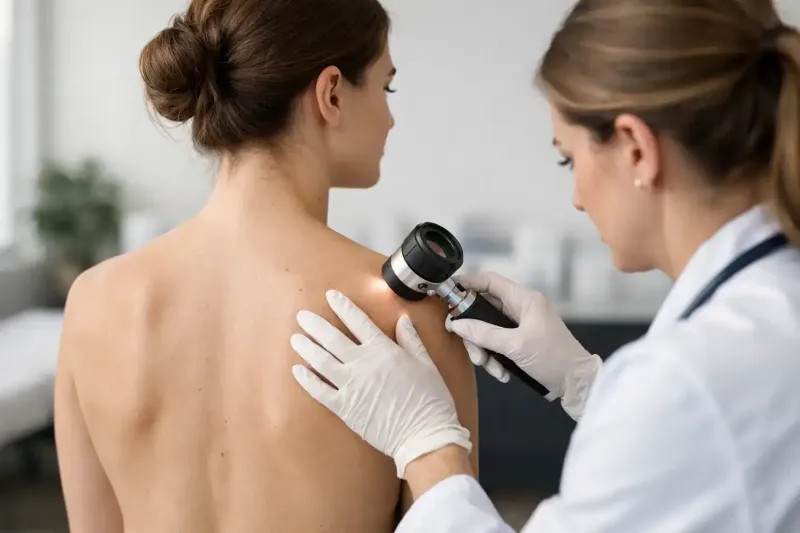
Photo: dermatologist full body skin exam patient dermatoscope clinic appointment, via www.goodmandermatology.com
For many patients, the annual full-body skin exam is a mystery. What exactly is the dermatologist looking for? Will it hurt? What happens if something looks suspicious?
The answers matter, because skin cancer is the most common cancer in the United States, and a regular professional skin check is one of the most effective tools for catching it early. Here is what actually happens during this quick, painless, potentially life-saving appointment.
Before You Arrive: How to Prepare
A little preparation makes the exam more productive. Skip nail polish on fingers and toes — melanoma can develop under the nails, and dermatologists need an unobstructed view. Remove makeup so facial skin can be assessed clearly. If possible, avoid wearing lotions or self-tanner, which can obscure the skin's natural texture.
It also helps to come with information. Note any spots that are new, changing, or symptomatic. Bring a family history of skin cancer or other cancers, a list of current medications, and, if you have taken photos of a concerning spot over time, bring those images. Patients with many moles may benefit from having a partner photograph hard-to-see areas like the scalp and back before the visit.
The Exam Itself: Systematic and Thorough
Once you change into a gown, the dermatologist will examine your skin from scalp to soles, typically in a head-to-toe sequence. This includes areas many patients never think to check: between the toes, behind the ears, the buttocks, the groin, and the spaces between fingers.
The central tool is the dermatoscope — a handheld magnifying device with built-in illumination that allows the physician to see structures beneath the skin's surface invisible to the naked eye. Research has shown that dermoscopy significantly improves dermatologists' accuracy in distinguishing benign lesions from melanomas compared with examination by eye alone.
The ABCDE Framework: How Dermatologists Evaluate Moles
Throughout the exam, your dermatologist is applying a set of criteria known as the ABCDEs of melanoma:
- A — Asymmetry: One half of the spot does not match the other.
- B — Border: Edges are irregular, ragged, or blurred.
- C — Color: The lesion contains multiple shades or uneven pigmentation.
- D — Diameter: The spot is larger than about six millimeters, roughly the size of a pencil eraser.
- E — Evolving: The mole is changing in size, shape, or color.
Dermatologists also watch for the "ugly duckling" sign — a mole that stands out from the rest of a patient's pattern — and for any lesion that bleeds, itches, or fails to heal, which can indicate other forms of skin cancer such as basal cell or squamous cell carcinoma.
What Happens If Something Looks Suspicious
If the dermatologist identifies a lesion of concern, the next step is usually a skin biopsy — a quick procedure performed with local anesthesia in which a small sample of tissue is removed and sent to a laboratory for microscopic analysis. Most biopsies take only a few minutes, and patients typically receive results within one to two weeks.
It is important to understand that a biopsy is a diagnostic step, not a verdict. The majority of biopsied lesions turn out to be benign. And if a lesion does prove cancerous, catching it at this stage usually means a simple in-office removal is all that is required.
Why Board Certification Matters
Not everyone offering skin exams has the same training. A board-certified dermatologist has completed medical school, a residency devoted entirely to the diagnosis and treatment of skin, hair, and nail conditions, and rigorous national board examinations. This training includes thousands of hours distinguishing benign from malignant lesions — expertise that directly translates into more accurate assessments, fewer unnecessary biopsies, and earlier cancer detection.
Patients can verify a dermatologist's board certification through the American Board of Dermatology and confirm membership in professional organizations committed to ongoing education and quality standards.
Questions Worth Asking at Your Visit
Patients get more from a skin exam when they participate. Useful questions include: How often should I have a full-body exam based on my risk? What should I watch for between visits? Am I using sunscreen correctly? Should I be performing self-exams at home, and how?
Your dermatologist can also demonstrate a monthly self-exam using a full-length mirror, a hand mirror, and good lighting — a habit that takes ten minutes a month and has been shown to help patients detect melanoma earlier.
An Investment of Fifteen Minutes
A full-body skin exam is brief, painless, and requires no preparation beyond a few simple steps. Yet it remains one of the most underused preventive health measures in American medicine. For anyone with a history of sun exposure, a family history of skin cancer, or simply skin that has never been professionally examined, this appointment is an investment whose payoff can be measured in years of life.